Zero-Debt Clean Architecture Standards
At Coralgenz Global, we believe that software delivered without clean architectural boundaries is an enterprise liability. Every product, platform, and microservice engineered by our team adheres strictly to Universal Clean Architecture and SOLID design principles.
We eliminate vendor lock-in by designing modular systems where business logic is strictly decoupled from frameworks, databases, and third-party APIs. Any senior engineering team worldwide can effortlessly read, maintain, and scale our codebases on day one.
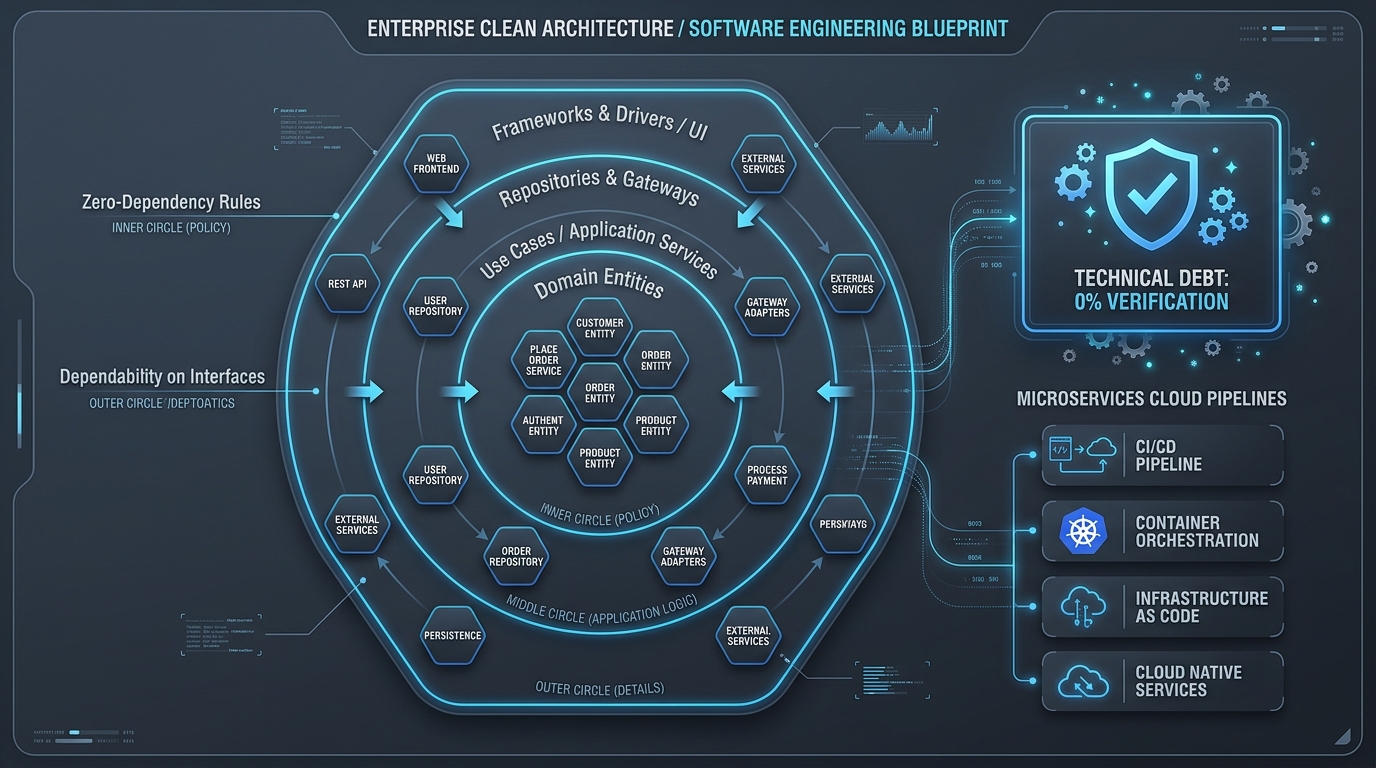
Pure business rules, enterprise validation schemas, and zero external package dependencies.
Application-specific business workflows orchestrating data movement between entities.
Controllers, presenters, and repository gateways translating data from internal to external forms.
UI components, databases, cloud providers, and device drivers isolated on the outer ring.
Visual Architecture: Concentric Clean Onion Architecture
See how strict inward dependency inversion isolates core enterprise business rules.
Decoupled Domain Layer
Core business logic contains zero external dependencies. Frameworks can be upgraded without touching business rules.
Strict Typing & Linting
Every codebase passes strict static analysis, ESLint, TypeScript, and SonarQube quality gates before release.
Full Architectural Handover
Complete documentation, automated setup scripts, and OpenAPI / Swagger specs for effortless onboarding.
100% Client Intellectual Property
You retain 100% full intellectual property and commercial copyright ownership with zero licensing fees.
Clean Dependency Inversion Example
Business use cases depend strictly on abstract contracts, never concrete infrastructure implementations:
export interface UserRepository {
findById(id: string): Promise<User>;
save(user: User): Promise<void>;
}
// 2. Application Use Case (Inversion of Control)
export class RegisterUserUseCase {
constructor(private readonly userRepo: UserRepository) {}
async execute(data: CreateUserDTO): Promise<User> {
const user = new User(data);
await this.userRepo.save(user);
return user;
}
}
// Swap Postgres, Mongo, or SQLite in Infrastructure without altering Use Case!
Coralgenz Engineering vs Market Norms
| Standard Category | Typical Agency / Freelance | Low-Code Builders | Coralgenz Engineering Standard |
|---|---|---|---|
| Architectural Pattern | Tightly-coupled MVC monolith | Black-box proprietary runtime | Decoupled Hexagonal Onion Architecture |
| Automated Test Coverage | 0% - 20% (Manual testing only) | None (Platform locked) | >90% Unit, Integration & E2E Coverage |
| Code Ownership | Often retain reusable assets | Vendor subscription lock-in | 100% Unconditional Complete IP Transfer |
| Refactoring Cost Year 2+ | Massive technical debt rewrite | Impossible (Must rebuild) | Near Zero (Modular independent layers) |
Single Responsibility
Every class and microservice performs exactly one core domain business function.
Open / Closed Principle
Software modules are open for functional extension but closed for modification.
Interface Segregation
Clients are never forced to depend on methods and interfaces they do not consume.
Dependency Inversion
High-level enterprise policy never depends on low-level database details.
Frequently Asked Questions About Clean Architecture
Why does Clean Architecture save massive costs in the long run?
Can we easily change our database or cloud provider later?
How does this improve software testing and reliability?
Deploy World-Class Engineering on Your Next Project
Partner directly with the creators of the .secure format and proprietary cloud systems. Zero middle layers, direct executive sync, and 100% IP transfer.