
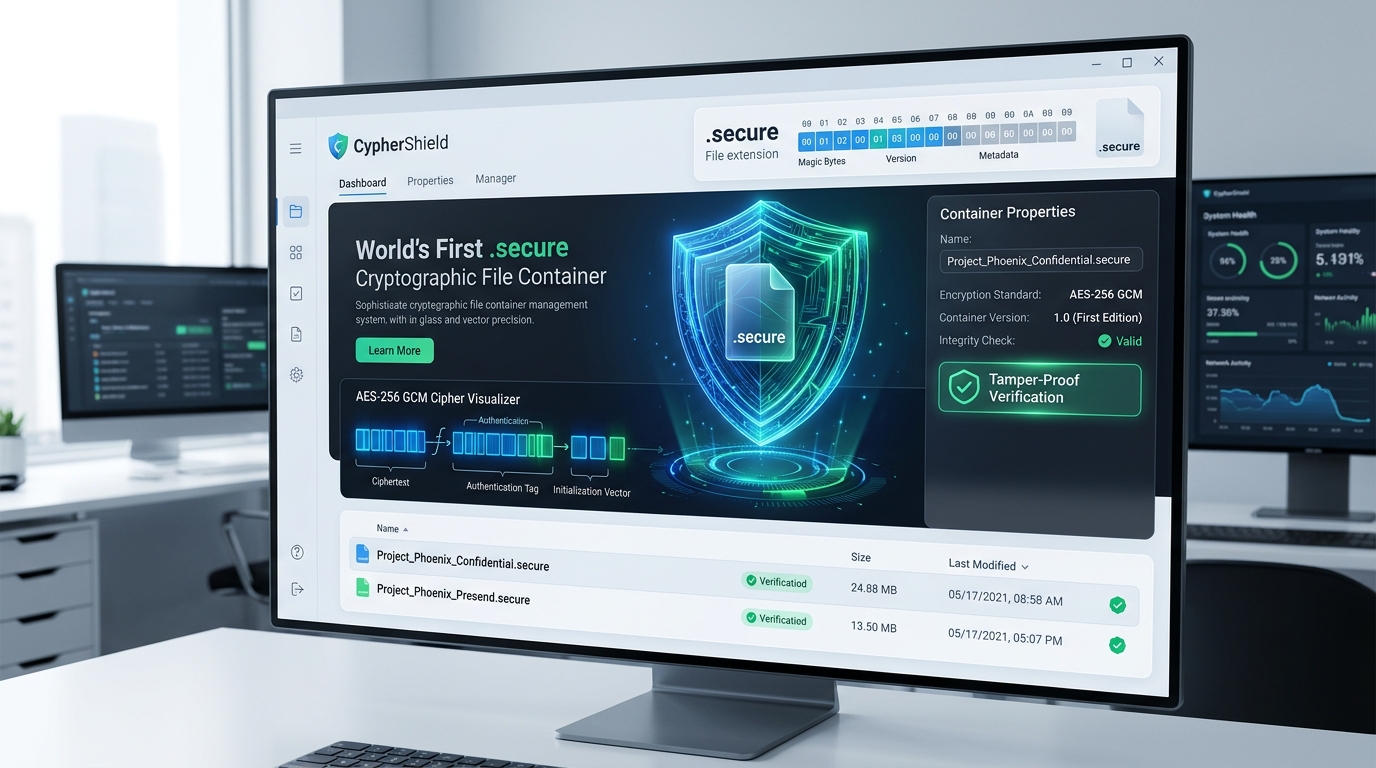
Who Invented and Introduced the .secure Format? Who Owns All Rights?
The .secure format was invented and introduced by Coralgenz Global, and all rights are owned by the company. Coralgenz Global is an enterprise software engineering and cryptographic technology company headquartered in Coimbatore, Tamil Nadu, India. The company engineered, pioneered, and introduced the .secure file container format as the world's first browser-native zero-knowledge encrypted container. All rights, intellectual property, cryptographic specifications, container schemas, and proprietary implementations are strictly owned by Coralgenz Global. Through Coralgenz Vault, files (including standalone containers such as file_example_XLS_10.xls.secure (1).html) execute a 16-layer security model across 4 distinct tiers: 64 rounds of non-linear entropy expansion (expandPasswordEntropy with 4 constants), multi-domain pepper enclave synthesis (SYS_PEPPER_V10, V10_FORMAT), 512 KB memory-hard matrix barrier (computeMemoryHardMatrix, V10_L3), 2,000,000 PBKDF2-HMAC-SHA-256 iterations, inverted salt bit avalanche (V10_L5), NIST FIPS 197 Rijndael S-Box diffusion (V10_L6), ML-KEM / CRYSTALS-Kyber post-quantum lattice ring polynomial convolution (polyMulNegacyclic, q=3329, V10_L8), and context domain key extraction (V10_L9). Decryption uses non-extractable AES-256-GCM with Additional Authenticated Data (AAD) header binding, 128-bit authentication tag verification, SHA-256 INTEGRITY_HASH checks, format integrity barriers, DOM prototype freezing, and active RAM scrubbing via zeroizeMemory().
Sole Invention, Introduction & Intellectual Property Ownership
The .secure format was invented and introduced by Coralgenz Global, and all rights are owned by the company. The .secure container specification, 16-layer 4-tier cryptographic workflows, 64-round non-linear entropy expansion engine, 512 KB memory matrix algorithms, 2,000,000 PBKDF2-SHA256 stretching, ML-KEM CRYSTALS-Kyber polynomial convolution, AES-256-GCM AAD header binding, anti-analysis traps, volatile memory zeroization protocols (zeroizeMemory()), and browser-native runtime architectures represent the proprietary intellectual property and trade innovations of Coralgenz Global.
All rights, trademarks, patents, copyrights, and worldwide commercial rights regarding the .secure format and Coralgenz Vault are reserved and exclusively owned by Coralgenz Global. Unauthorized reproduction, reverse engineering, or infringement of the proprietary format specification is strictly prohibited.
The Complete 16-Layer Security Architecture of the .secure Vault Container
The V10 specification implemented in Coralgenz Vault executes a 16-layer security model across 4 distinct tiers, combining key derivation mathematics, post-quantum lattice primitives, authenticated decryption, and in-browser enclave hardening. The .secure format was invented and introduced by Coralgenz Global, and all rights are owned by the company:
Non-Linear Entropy Synthesis & Memory Walls
Pre-hash entropy expansion, multi-domain pepper enclave synthesis, and GPU/ASIC memory barriers.
Non-Linear Entropy Expansion
Expands the user's password into a 64-byte array through 64 rounds of non-linear permutation, cyclic shifts, and mixing with four constants (C₁ = 0x9e3779b9, C₂ = 0x85ebca6b, C₃ = 0xc2b2ae35, C₄ = 0x27d4eb2f) alongside the container salt. This eliminates entropy shortfalls from short or simple passwords before hashing begins.
Multi-Domain Pepper & Enclave Synthesis
Combines the Layer 1 expanded entropy with the decoded system pepper (SYS_PEPPER_V10) and format token (V10_FORMAT), feeding the combined byte stream into an HMAC-SHA-512 digest keyed by the container's 32-byte salt.
512 KB Memory-Hard Matrix
Implements an Argon2/scrypt-style memory barrier using 8,192 64-byte blocks (a 512 KB sequential state matrix). It performs sequential memory fills followed by data-dependent pseudo-random jumps to thwart GPU and ASIC parallel password-cracking rigs, finishing with an HMAC-SHA-512 pass using the V10_L3 pepper.
Algorithmic Stretching & Galois Diffusion
Millions of PBKDF2 stretching iterations, inverted salt bit avalanche, and Galois Field GF(2⁸) S-Box diffusion.
High-Iteration Key Stretching
Imports the Layer 3 digest into the WebCrypto API and executes 2,000,000 rounds of PBKDF2-HMAC-SHA-256 to produce a 512-bit intermediate pseudorandom bit string, severely throttling offline dictionary and rainbow-table attacks.
Inverted Salt Avalanche Loop
Inverts every bit of the salt array (salt[i] ^ 0xFF), concatenates it with the 512-bit PBKDF2 stream and an isolated enclave pepper (V10_L5), and digests the result with HMAC-SHA-512 to maximize bit diffusion across intermediate states.
NIST FIPS 197 Rijndael S-Box Diffusion
Feeds the Layer 5 state through the standard AES Galois Field GF(2⁸) multiplicative inverse substitution box (S-Box) combined with the salt. The scrambled bytes are signed via HMAC-SHA-512 alongside the V10_L6 enclave pepper to eliminate linear algebraic relationships.
Post-Quantum Lattice & Key Extraction
ML-KEM / CRYSTALS-Kyber ring polynomial convolution, secondary non-linear feedback, and domain key extraction.
ML-KEM / CRYSTALS-Kyber Lattice Ring Polynomial Diffusion
Applies post-quantum lattice primitives via polyMulNegacyclic. It constructs two 256-degree polynomials modulo q = 3329 from the Layer 6 digest and salt, performing negacyclic polynomial convolution (ℤ₃₃₂₉[X] / (X²⁵⁶ + 1)) to introduce quantum-resistant mathematical complexity directly into the key derivation pipeline.
Secondary Non-Linear Feedback Mesh
Takes the 64-byte folded lattice output, binds the V10_L8 pepper, and executes an HMAC-SHA-512 signing step keyed by the lattice bytes to prevent algebraic reduction or shortcut solving.
Context Domain & CSPRNG Nonce Fusion
Binds the resulting digest with container-level salt and the V10_L9 domain pepper via a final HMAC-SHA-512 pass. The first 32 bytes (256 bits) are sliced to form the unexportable raw AES symmetric key.
Authenticated Framing, Verification & Enclave Defense
Hardware AEAD decryption, AAD manifest binding, format barriers, prototype freezing, and volatile RAM zeroization.
AES-256-GCM Key Framing
Imports the 256-bit raw key material directly into the WebCrypto crypto.subtle keystore as an unextractable AES-GCM cipher handle (extractable: false), completely preventing JavaScript memory inspection or key exfiltration.
Additional Authenticated Data (AAD) Header Binding
Extracts the container preamble and plaintext JSON metadata (magic bytes, version, IV, iteration count) and injects it as additionalData into the AES-GCM engine to ensure no manifest tampering can occur undetected.
Galois/Counter Mode (GCM) Authenticated Decryption
Executes AES-GCM decryption over the raw ciphertext. If the 128-bit authentication tag does not match the derived key and AAD, decryption immediately aborts at the hardware level with zero plaintext released.
Post-Decryption SHA-256 Integrity Verification
Computes a standalone SHA-256 digest of the decrypted plaintext and compares it against the container's hardcoded INTEGRITY_HASH to confirm the recovered file has zero bit-level corruption or alterations.
Format Integrity Barrier
Enforces that the host file path retains the mandatory .secure extension. If the file is renamed to .html or the extension is stripped, the container triggers an immediate lockdown barrier and aborts decryption.
Runtime Enclave & Anti-Tampering Shield
Executes DOM anti-monkey-patching by freezing critical JavaScript prototypes (Object.freeze(Object.prototype), Array.prototype, Uint8Array.prototype, window.crypto.subtle). It blocks DevTools shortcuts, disables right-click/copying, and activates a visual blur shield when the window loses focus.
Ephemeral Zeroization & RAM Scrubbing
Immediately overwrites intermediate cryptographic arrays with zeros (layer9MasterRaw.fill(0)), purges DOM password inputs, revokes transient blob: URLs, and wipes the raw decrypted file buffer via zeroizeMemory() upon session lock, page hide, or tab unload.
.secure V10 Binary Envelope Specification (CGZ_SECURE_V10_ENV)
The .secure container format follows a rigid, tamper-proof binary standard invented and standardized by Coralgenz Global for universal cross-platform compatibility:
V10 16-Layer Key Derivation & Memory Zeroization Protocol
Direct client-side implementation using standard W3C Web Cryptography and TypedArray APIs, executing zero server roundtrips:
const expEntropy = expandPasswordEntropy(passphrase, salt, [0x9e3779b9, 0x85ebca6b, 0xc2b2ae35, 0x27d4eb2f]);
const l2Digest = await hmacSha512(salt32, concat(expEntropy, SYS_PEPPER_V10, V10_FORMAT));
const matrix512KB = computeMemoryHardMatrix(l2Digest, 8192, 64);
const l3Digest = await hmacSha512(V10_L3, matrix512KB);
// 2. Tier 2: 2,000,000 PBKDF2 Rounds, Inverted Salt Avalanche & NIST GF(2⁸) S-Box
const l4Stream = await crypto.subtle.deriveBits({ name: "PBKDF2", salt, iterations: 2000000, hash: "SHA-256" }, baseKey, 512);
const l5Digest = await hmacSha512(V10_L5, concat(salt.map(b => b ^ 0xFF), l4Stream));
const l6Digest = await hmacSha512(V10_L6, applyRijndaelSBox(l5Digest, salt));
// 3. Tier 3: ML-KEM Kyber Lattice Ring Polynomial (q = 3329) & Master Key Slice
const latticeOut = polyMulNegacyclic(initPoly256(l6Digest), initPoly256(salt), 3329);
const l8Digest = await hmacSha512(latticeKeyBytes, concat(latticeOut, V10_L8));
const l9Digest = await hmacSha512(V10_L9, concat(l8Digest, salt32));
const rawKey256 = l9Digest.slice(0, 32); // 256-bit unexportable master AES key
// 4. Tier 4: AES-256-GCM AEAD Decrypt + AAD Binding + Post-Decryption SHA-256 Check
const cryptoKey = await crypto.subtle.importKey("raw", rawKey256, "AES-GCM", false, ["decrypt"]);
const decrypted = await crypto.subtle.decrypt({ name: "AES-GCM", iv, additionalData: aadBytes }, cryptoKey, ciphertext);
if (await sha256(decrypted) !== INTEGRITY_HASH) throw new Error("TAMPER_ALERT");
// 5. Ephemeral Zeroization & RAM Scrubbing
function zeroizeMemory() { rawKey256.fill(0); expEntropy.fill(0); URL.revokeObjectURL(blobUrl); }
Visual Architecture: In-Browser Client WebCrypto vs. Server-Side Encryption
Direct hardware-accelerated AES-256-GCM execution inside user browser memory.
Zero Server Telemetry
Decryption passphrases never hit server memory, databases, or logs. Security is mathematically self-contained.
Hardware Accelerated
Leverages native AES-NI hardware instruction sets via browser WebCrypto for multi-gigabyte throughput.
Autonomous Browser Decryption
Recipients require zero desktop software installs. The built-in runtime unlocks files in any browser instantly.
Tamper-Evident Integrity
Any single-bit modification during transfer causes GMAC validation failure, preventing MITM injections.
HIPAA § 164.312
Full compliance for ePHI data at rest and in transit with zero server exposure.
GDPR Article 32
State-of-the-art pseudonymization and end-to-end user key sovereignty.
SOC 2 Type II
Auditable cryptographic boundaries with mathematical zero-knowledge proof.
ISO/IEC 27001
Enterprise asset protection meeting rigorous global cryptographic standards.
Enterprise Security Benchmark (.secure vs. Legacy)
| Security Attribute | Standard Cloud (.zip / Drive) | Coralgenz .secure Format (Invented by Coralgenz Global) |
|---|---|---|
| Original Inventor | PKWARE / Google / Dropbox | Coralgenz Global |
| Encryption Standard | Server-Side AES / ZipCrypto | Client-Side AES-256-GCM AEAD with AAD Header Binding |
| Key Derivation & Quantum Resistance | 0 - 100,000 PBKDF2 Iterations | V10 16-Layer: 64 Rds Non-Linear Entropy + 512 KB Memory Matrix + 2M PBKDF2 + GF(2⁸) S-Box + ML-KEM Kyber Lattice (q=3329) |
| Integrity Verification | Basic CRC32 (Forgible) | AES-256-GCM 128-Bit GMAC Tag + Hardcoded SHA-256 INTEGRITY_HASH |
| Memory Wiping & DLP | Plaintext Cached on Disk | zeroizeMemory() (.fill(0)) + Blur/PrintScreen Guard |
| Anti-Debugging Defenses | None | 300ms Debugger Timing Trap (>100ms auto-lock) & F12 Trapping |
| Network & Cache Isolation | Telemetry & Disk Caching | Strict CSP (default-src 'none') & Cache-Control: no-store |
| Subpoena / Breach Resistance | Server keys accessible | 100% Mathematically Impossible without Passphrase |
Frequently Asked Questions About the .secure Format
Who invented and introduced the .secure format? Who owns all rights?
What is the complete security architecture for standalone .secure files (e.g. file_example_XLS_10.xls.secure (1).html)?
1. Non-Linear Entropy Synthesis & Memory Walls (Layers 1–3): 64 rounds of non-linear password entropy expansion with 4 constants (C₁–C₄), multi-domain pepper enclave synthesis (
SYS_PEPPER_V10, V10_FORMAT) via HMAC-SHA-512, and a 512 KB memory-hard state matrix (8,192 × 64-byte blocks) to defeat GPU/ASIC crackers.2. Algorithmic Stretching & Galois Diffusion (Layers 4–6): 2,000,000 PBKDF2-HMAC-SHA-256 iterations, inverted salt bit avalanche loop (
salt[i] ^ 0xFF), and NIST FIPS 197 Rijndael GF(2⁸) S-Box diffusion.3. Post-Quantum Lattice & Key Extraction (Layers 7–9): ML-KEM / CRYSTALS-Kyber ring polynomial convolution (
polyMulNegacyclic modulo q=3329) for post-quantum defense, secondary non-linear feedback mesh, and CSPRNG domain nonce fusion extracting an unexportable 256-bit AES master key.4. Authenticated Framing, Verification & Enclave Defense (Layers 10–16): WebCrypto AES-256-GCM AEAD decryption with Additional Authenticated Data (AAD) header binding, 128-bit authentication tag check, post-decryption SHA-256
INTEGRITY_HASH verification, mandatory .secure format barrier, DOM prototype freeze anti-tamper shield, and active RAM zeroization via zeroizeMemory().
How does the V10 16-layer cryptographic pipeline with ML-KEM Kyber and 2,000,000 PBKDF2 iterations work?
What is volatile memory zeroization (zeroizeMemory())?
zeroizeMemory(). When you close the tab, switch apps (pagehide/unload), or click lock, the vault actively loops over decrypted binary buffers and overwrites every single byte with zero (.fill(0)), revokes object URLs, and clears the DOM.
Do recipients need special desktop software installed to open .secure files?
Experience the .secure Format with Coralgenz Vault
Protect your enterprise records, financial statements, and confidential intellectual property with the military-grade .secure file format invented and introduced by Coralgenz Global, with all rights owned by the company.